
There is something honest about a beet. It is not flashy or engineered, and it does not try to be anything other than what it is—a root pulled from the ground, carrying the story of the soil it came from, deep in color and quietly powerful in a way that feels more steady than dramatic. When it comes to endurance, that kind of power matters more than we often realize.
Performance today is usually framed around optimization, where we isolate variables, extract compounds, and package them into something faster, stronger, and more efficient, whether that is beet powder, nitrate shots, or any number of supplements promising marginal gains. But endurance is not built on isolated inputs, and the body does not operate like a simple equation where more of one compound automatically leads to better results. It is built on systems, and those systems begin in the soil.
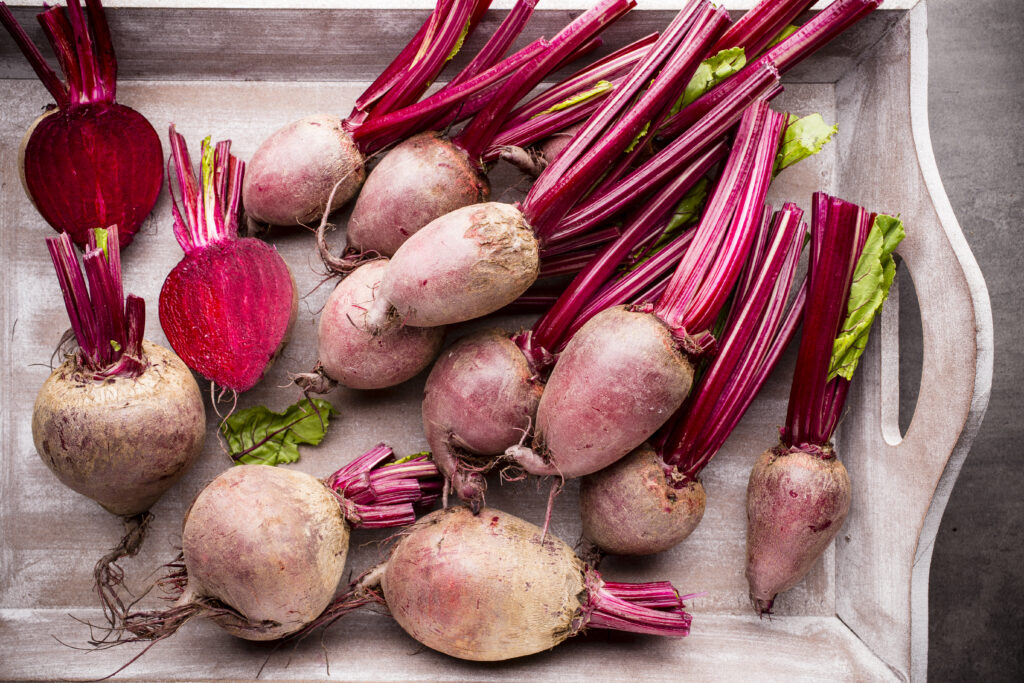
A fresh, local, organic beet is not just a vegetable in the conventional sense, but the expression of a living ecosystem. Healthy soil is alive with microorganisms cycling nutrients, fungi building structure, and minerals moving in balance, all working together in a way that allows the plant to develop with integrity rather than force. When a beet grows in that environment, it becomes part of that system, and what ends up on your plate carries that complexity forward in a way your body is uniquely equipped to recognize.
There is a reason beets have become a staple in endurance training conversations, and it is not just anecdotal. They are naturally rich in dietary nitrates, which the body converts into nitric oxide, a compound that supports blood vessel dilation, improves blood flow, and enhances oxygen delivery during exercise. In practical terms, that can mean greater efficiency, where the body is able to do more with less effort over time, something every endurance athlete is chasing whether they frame it that way or not.
To put it simply, the performance relevance of beets often comes down to a few key physiological benefits:
- Improved blood flow through nitric oxide production
- More efficient oxygen utilization during sustained effort
- Potential reductions in perceived exertion over longer durations
These are real effects, and they explain why beet juice and supplements have found their way into training routines. However, focusing only on nitrates tells an incomplete story, and in many ways, it misses the part that matters most.
A beet is not just a nitrate delivery system, and reducing it to that function strips away the very thing that makes it effective. A whole, fresh beet also contains fiber that slows digestion and stabilizes energy release, minerals like potassium and magnesium that support muscle function, iron and folate that contribute to oxygen transport and recovery, vitamin C that enhances absorption, and a range of phytonutrients such as betalains that help manage oxidative stress. These elements do not act independently, nor do they simply stack on top of one another as if the body were adding them up in isolation. They interact, support, and modulate each other, creating a response that is far more integrated than anything a single extracted compound can replicate.
This is where the idea that food is merely the sum of its nutrient parts begins to fall apart. In reality, food behaves more like a network than a list, and the body responds accordingly, processing not just what is present but how it is presented, how it is structured, and what accompanies it.
It is easy to assume that concentration equals effectiveness, that a more potent dose of nitrates in powder form must be superior to a whole beet, but absorption does not work that way. Whole foods come packaged with the cofactors the body relies on to process nutrients effectively, influencing everything from digestion speed to metabolic response and the timing of energy availability. When you consume a beet powder, you may experience a more immediate spike in a specific compound, but when you eat a fresh beet, you receive a more sustained and balanced release, one that aligns more closely with the demands of endurance itself.
The distinction becomes clearer when viewed side by side:

Raw Organic Nutrient-Dense Beets
provide a complete nutritional system, supporting steadier energy release, improved absorption through nutrient synergy, and a response that is more consistent over time.
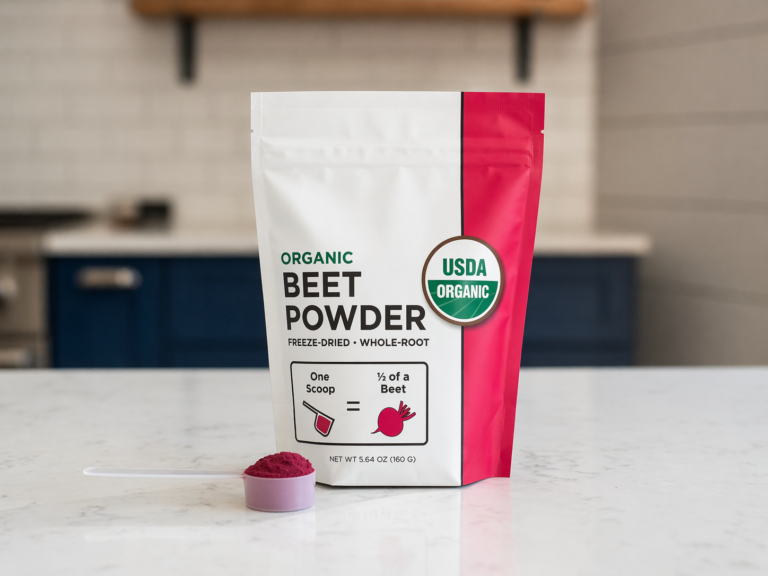
Organic Concentrated Beet Powder
deliver isolated or highly concentrated compounds, often leading to faster but less sustained availability, without the full spectrum of supporting nutrients that influence how those compounds are used.
For endurance athletes, this difference is not theoretical, because performance is rarely defined by short bursts of output alone; it is defined by the ability to sustain effort, manage fatigue, and recover well enough to repeat the process consistently.
There is also a qualitative difference that is harder to measure but easy to feel. Anyone who has trained regularly knows the contrast between energy that arrives quickly and fades just as fast, and energy that builds gradually and holds steady. Fresh, whole foods tend to produce the latter, offering a kind of stability that aligns with the rhythm of endurance rather than working against it. A roasted beet with a bit of olive oil and salt does not feel like a shortcut or a hack; it feels like something the body understands, something it knows how to use without resistance.
Freshness itself plays a meaningful role in this equation, and it is often overlooked. The closer food is to the moment it was harvested, the more intact its nutritional profile remains, as vitamins degrade over time, flavor diminishes, and structural integrity changes. Local food shortens that gap, and when it is grown organically in healthy soil, it preserves not just nutrients but the relationships between them. What you are getting is not simply fresher food, but food that retains more of its original complexity.
None of this is to suggest that supplements have no place, because they can serve a purpose in specific contexts, particularly when convenience or timing becomes a constraint. However, they are best understood as tools rather than foundations, and problems tend to arise when they are treated as replacements for whole foods rather than complements to them.

At its core, food is not just fuel, nor is it simply a delivery mechanism for isolated nutrients. It is information, context, and relationship, shaping how the body functions over time rather than just in a single moment. When you eat a fresh, local, organic beet, you are not just supporting a workout or a training block, but participating in a system that connects soil, plant, and performance in a way that is both simple and deeply interconnected.
Endurance is often framed as pushing harder, as if the goal is always to extract more from the body, but in practice, it is far more about sustaining better, about building a foundation that allows for consistency rather than peaks and crashes. That foundation begins long before the workout itself, and it is shaped, in no small part, by what you choose to put on your plate.
A beet will never promise anything dramatic, and it will not position itself as a breakthrough or a shortcut, but it will offer something more valuable in the long run, pun intended. It will support you steadily, quietly, and reliably, in a way that compounds over time, and that is ultimately what performance is built on.